
[Event Report]Disaster × Diversity Seminar:A Human Rights Approach to Disaster Recovery: Lessons from the Great East Japan Earthquake
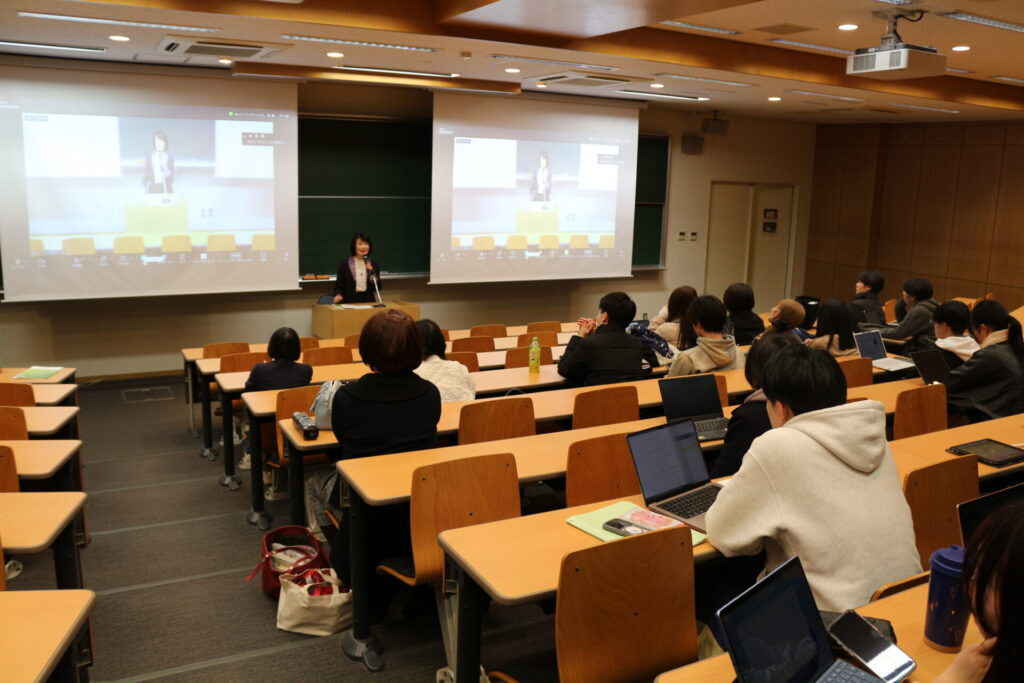
Date & Time: January 21, 2026 (Wed), 14:40–16:10
Format: Hybrid (in-person and online)
Venue: Theater Classroom, Research Building No. 1, Saitama University
Participants: 61 (22 members of the general public, 39 students)
Speaker: Mutsuko Tendo
Professor Emerita, Miyagi Gakuin Women’s University
(Co-editor of Creating Disaster Women’s Studies, Seikatsushisosha, 2021)
The Center for Gender, Diversity and Inclusion and The Resilient Society Research Group of The Center for Social Transformation jointly hosted a Disaster × Diversity seminar titled “A Human Rights Approach to Disaster Recovery: Lessons from the Great East Japan Earthquake,” welcoming Professor Emerita Mutsuko Tendo as the guest speaker.
At the beginning of her talk, Professor Tendo pointed out that concepts such as “citizens,” “rights,” and “equality,” which may appear neutral at first glance, in fact reflect existing power relations within society. She raised a fundamental issue: “Disasters do not affect everyone equally. To varying degrees, human-made harm rooted in social vulnerability and structural inequality disproportionately impacts those in weaker positions.”
She then introduced analyses from the Great Hanshin-Awaji Earthquake, which resulted in a large number of fatalities. In that disaster, the number of female victims was 36% higher than that of men. This disparity has been understood in relation to the “housing disaster” aspect of the earthquake, namely insufficient seismic resistance of housing. Through this example, she emphasized the necessity of recognizing disaster damage as a social issue rather than merely a natural phenomenon.
Within this context, Professor Tendo stressed the importance of what she described as “feminist imagination”—the capacity to place oneself in the position of others and to imagine their worries, pain, and difficulties. Through this imagination, unjust treatment toward women and minorities can be recognized, and both theoretical and practical approaches to correcting such injustices can be envisioned.
She further discussed the significance of women gaining power and becoming empowered, as well as the transformative and creative potential that emerges from solidarity. She expressed strong expectations for bottom-up change driven by grassroots women who act collectively to transform their own conditions and social positions.
The seminar was also conducted as part of a university course (Diversity and Welfare Studies), allowing students and members of the general public to participate together.
Below are selected comments from participant surveys:
- “Professor Tendo’s lecture, like the field of disaster women’s studies itself, moved back and forth between theory and practice. I found it fascinating as a discipline deeply grounded in real social conditions. I also enjoyed attending together with students.” (General participant)
- “I feel more strongly than ever that this is an era in which we must reexamine the concept of ‘human rights.’ The most important thing is ‘human recovery.’ Disaster prevention and mitigation must be considered from this perspective.” (General participant)
- “The phrase ‘disasters do not affect people equally’ left a strong impression on me. I had learned about the difficulties faced by women and people with disabilities during disasters, yet I still held the idea that everyone suffers equally regardless of social status. I realized that even I might think that way during a disaster. Simply holding this awareness encourages us to constantly consider whether there are people in more vulnerable positions and whether they are struggling. I believe it is important to internalize this way of thinking in everyday life.” (Student)
- “It is essential that not only experts and government officials, but each of us continues to learn about gender equality and human rights and to cultivate our imagination. Going forward, I want to think about what I can do in daily life, viewing disaster and gender issues not as ‘special topics’ but as integral to my own life and to society.” (Student)
- “The actual data showing that in both the Hanshin-Awaji Earthquake and the Great East Japan Earthquake, the number of female fatalities was about 1,000 higher than that of men strongly demonstrates the unequal social structure in which men are prioritized over women. Before this lecture, I wondered why gender issues that surface during disasters tend to remain hidden in normal times. Through this class, I realized that this invisibility exists because a society in which women cannot raise their voices has already been formed. I learned how crucial everyday efforts toward gender equality are.” (Student)